A short cell phone recording of something I’ve been working on. Enjoy.
happy Friday
October 10th, 2013Macronutrient Ratios and Energy Deficit
September 25th, 2013This is less an informational post than it is an attempt to articulate a major gap in my understanding of nutrition.

When I first entered the fat loss world, I gleaned that I needed to be in a calorie deficit — but that was about it. I’ve experimented with serious calorie restriction + lots of steady state cardio, a vegetarian diet, cyclical ketogenic diet + mild lifting, and IF carb cycling + heavy lifting á la Leangains.
In all that time, I’ve learned a few different things.
- Tracking food intake is key.
- You hit your macros, and good things happen.
- Lifting heavy + sufficient protein = muscle growth/conservation.
The basics don’t really change, but there seem to be differing voices regarding what is possible in terms of fat loss and specifically recomposition. I understand and accept that a deficit is required to lose fat. Energy requirements will be pulled from circulating macronutrients and then from fat stores after that has been exhausted.
The ideal (fantasy) case would look like this:
- Every gram of protein goes to grow muscle tissue.
- Every gram of carbohydrate goes either to fuel training or your brain.
- Every gram of fat goes to fuel other activity.
- Energy requirements unsatisfied by dietary fat are taken directly from fat stores.
We try to manipulate macronutrient ratios such that as much protein as possible goes to muscle growth and as much energy as possible comes from fat storage, but to my knowledge, such a golden ratio as above does not exist. If it did, we could eat more calories and still be in a deficit because our caloric needs would be increased in the process of building muscle.
That being the case, we try to supply enough protein to retain existing muscle mass or possibly grow it in a deficit. A small overestimation is preferable to catabolism.
However, things get much trickier with carbohydrate and fat intake. I’ve heard two different thought processes, and I’m not sure if they are mutually exclusive or just different ways of attacking the same problem.
Cyclical Ketogenic vs Higher-Carb Cycling:
The low-carb (by which I mean < 100g / day) folks emphasize that insulin spikes are undesirable in a fat loss program because they provide the perfect environment for fat storage. However, it is my understanding that calorie deficits being equal, any stored fat would be shuttled right back out for usage at some point in the day when the energy deficit takes effect. With an equal calorie intake, circulating protein and fat would (theoretically) be used for energy, thus cancelling out any benefit to avoiding an insulin spike. (It doesn't matter if dietary fat is stored and then released or just stays in circulation longer... it all has to be used before existing body fat will be accessed.) The low-carb writers I’ve read also recognize that insulin is necessary for shuttling glycogen into the muscles, but that is emphasized more for bulking and seems to be ignored in the cut except during a refeed. (I’m ignoring leptin and assuming refeeds are taking place to keep those levels up.)
I’m still confused as to what role ketogenesis plays in the process besides providing an alternate source of fuel with equal calorie burn given an equal deficit.
When I trained with Andy Morgan, obviously we used IF and carbohydrate cycling. Higher carbs on training days were alternated with significantly low carbs on rest days, as specified in the Leangains protocol. The only real explanation I ever read for the seriously low carbs on rest days was to allow more protein and fat into the diet, the fat being used to keep certain hormone levels up.
Leangains also stresses removing the obsessive nature of meal timing, but almost all the protocols suggest consuming most calories in the post-workout window. The only possible reason for this in a deficit state would be nutrient partitioning for muscle growth/preservation.
In the end, adherence to the calorie deficit is king, and that’s why I currently use a lower carb diet — I’ve found I’m more compliant with it. However, assuming I could keep compliance, I wonder if there would be a partitioning benefit to increasing the carb:fat ratio. If I were able to shuttle more protein to muscle, I could theoretically maintain equal fat burn while increasing protein to whatever level my muscles would accept it.
Summary:
Here are my lingering questions:
- Given an equal deficit and adequate protein, are insulin spikes undesirable, desirable, or irrelevant in terms of body composition?
- Is there an ideal ratio when combining resistance training with a deficit, and does meal timing have a significant effect on that?
- Is there any benefit to ketogenesis for fat loss besides adherence issues?
- If you are able to direct nutrient partitioning to muscle anabolism, are you effectively increasing your caloric burn by that very process?
I welcome the thoughts of any who wish to address my amateur ramblings.
Eating Out on a Diet
September 16th, 2013You’ve done your homework and are seriously engaged in a fat loss endeavor. You’re probably tracking your food intake — you know how many calories you will eat in a given day and the macronutrient breakdown. If that applies to you, then you will understand what I’m about to say:
The week is humming along. You’re hitting those macros, but you can feel it — looming in the distance. This is an evil presence, sharpening its claws and threatening to tear your diet apart. You are going to be eating… OUT.
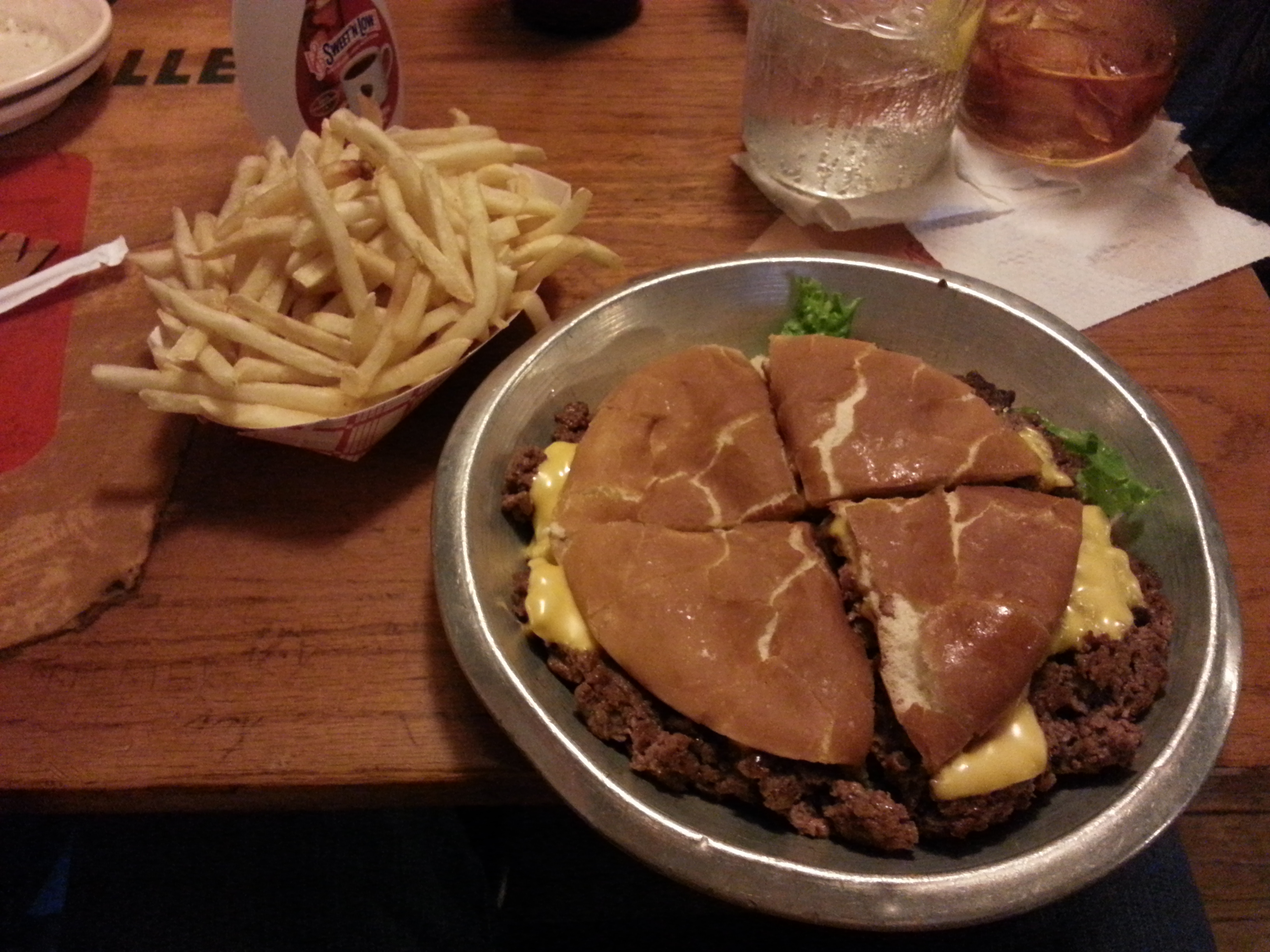
Maybe there is a work function. Perhaps you scored a date (good job!), or you just have a life on Fridays. Whatever the reason, it will come, and it will test you. For the unprepared, it can pose an extra hurdle to fat loss. Don’t you have enough of those already?
Of course, this is not a problem if you’re going to a chain restaurant; most have full nutrition information available. Just plan early what you will eat at the restaurant, and you’ll know what macros you have to play with for the rest of the day. Done deal.
Let’s be honest, though: chain restaurants are never going to beat individual establishments. Guys, do NOT take a girl to Chili’s. Just don’t.
You can almost guarantee a single establishment won’t provide nutrition information. I wish they did, but it’s expensive to get food tested and most restaurants are running on pretty thin profit margins as it is. Of course, they could tell you the contents of every dish, but then they’d be giving away trade secrets. Unless you want to boycott some seriously tasty eats, here are my tips for counting calories in a real restaurant:
- Check out the menu ahead of time. Most often, you know where you’ll be eating by at least the night before1. Find the website and see what’s on the menu. If you plan ahead of time to have the grilled chicken instead of pizza and french fries, you’re more likely to stick to that decision. Don’t be waylaid by the wiles of sneaky mashed potatoes you weren’t expecting. If you wait to decide how far things are going to go until you’re already in the back seat… well good luck with that. Once you know the menu:
- Pick something you can fit into your diet. You don’t always have to get Tilapia. I’m planning on having Chicken & Waffles this very night, but I’ve worked it into my macros for the day. Sometimes, you will have to make sacrifices. I’ll give you an example: this weekend, I went to a popular local Mexican joint for a friend’s birthday. The only thing I could possibly order without blowing away my carb count was Fajitas. Here was the description: “Grilled chicken breast, rice, beans, guacamole, flour tortillas, pico-de-gallo, chips and hot sauce.” Clearly, that wouldn’t cut it, so I modified the menu. I asked for chicken fajitas without anything else except refried beans. Oh, and I can already hear you screaming, “Well how do I know if I can fit it into my diet if there is no nutrition info?!?” I’m so glad you asked.
- Find similar foods. From this weekend’s example: I ball-parked the chicken at roughly 8 oz. Then, I recorded it as John Soules Chicken Fajita meat, for which I *do* have nutrition information. I estimated the refried beans as nearly a cup, and recorded them as 0.9 cups of canned refried beans. I gauged the amount of sauteed onions and sauteed peppers and found them(fat included in cooking) in my tracking app as well. If you’re worried about accuracy, purposefully overestimate on the amounts to give yourself a cushion. Maybe it won’t be exact, but I can guarantee it is close enough for tracking purposes.
- Learn to use a food scale. If you don’t have a food scale, stop reading this and get one. I currently use this from Amazon. A good food scale will increase accuracy when you are preparing your own food. I weigh out my lucky charms, chicken, and basically anything that is not liquid. Sometimes I even weigh liquids too (almond milk, etc). More to the topic at hand, though — regular use of a food scale will make you pretty accurate when ball-parking food amounts. I weigh out chicken almost every day, so I know what 4 oz of chicken looks like. Of course, you could take a scale with you, but you risk your friends/date/co-workers judging you as insane. Until such day as accurate food tracking becomes socially acceptable, you may be forced to hone your estimation skills. Finally, even if yours are undeveloped, you can:
- Call ahead. Maybe you’ve found an item or two on the menu you can work with, but you don’t know whether you’re dealing with a 4 oz cut of steak or 8. If you call before things get busy, most places will try and find the information for you. Sometimes you’ll get lucky and they’ll actually have nutrition information available that wasn’t advertized. (Once, Texadelphia printed me out a whole sheet that wasn’t on their website. Score!) Ask for whatever information you need to feel good about your choice. If the restaurant wants your business, they will oblige.
Hopefully, these tips will give you a fighting chance when you’re eating out. It’s not easy, but you can definitely tip the odds toward your success with a little work. Bon appetit, and good luck!
Week in Japanese: Kanji learnification
August 14th, 2013In preparation for my most recent trip to Japan (yes, it was awesome… I’ll post some pics or something later), I got serious about learning Japanese. According to this dude, learning the Kanji is the first step to owning the language like a boss.

If only I could read!!
I’ve tried a few different methods, including Kanji In Mangaland and Kanji Damage, but it was always difficult to stick to a schedule without tests or teachers looming over my shoulder.
Enter WaniKani.
This is, by far, the most effective and rapid Kanji acquisition program I’ve used. Here is how I’d describe it:
- It is
likea game. You level up as your skills increase, just like in RPGs. - It’s addictive. I look forward to doing reviews, I yell at myself worse than in Doodle Jump when I make a mistake, and leveling up is just as gratifying as it is in Elder Scrolls.
- The goal is ambitious! You learn ~1700 Kanji and ~5000 vocabulary in the space of 1.5 – 2 years.
- The community is active. There is serious camaraderie among people who want to learn Kanji and are using the same method to do so. Inside jokes abound and the founders of the program interact with users on a regular basis in the forums.
The main benefits I see are:
- It keeps you doing the actual work of learning Kanji. No matter how efficient a system is, it won’t work without actually looking at Kanji and getting them into your brain. This system ensures that you actually do that because you want to do it. Somehow, the immediate feedback (“you got X% of your reviews right”), the level up system (“your current skill level is X”), and the limit on reviews (“you have to wait X hours before you can do your next review”) combine to keep me raring to go for my next review session.
- It decides for me what information I need to know. One of the major difficulties in learning Kanji is the number of readings each can have. I’m a perfectionist, and if a book tells me that 好 can be read 9 different ways, then darned if I’m not going to learn them all before I move on to the next Kanji, much less study vocabulary that actually uses that particular Kanji. That is a debilitating way to go about it and WaniKani sidesteps the issue. It only teaches me the most frequent reading first, and later adds additional readings as they become necessary for vocabulary. Using WaniKani, I’ve become more proficient with ~125 Kanji in a month than I had with ~10 Kanji in multiple instances of starting, giving up, and starting again from scratch.
- The mnemonic devices are really good. Usually, I have to make up my own mnemonics to memorize vocab for a language I’m learning, but WK does that work for me, too. There is a whole system that builds on previously learned elements, and the stories are hilarious. Let’s just say Charlie Sheen features heavily in the descriptions.
The downsides are:
- It is designed for newbies. Currently there is no way to jump in at level 10 if you already know a bunch of Kanji. Everyone starts at the beginning and there is no option to speed up the review process. If you don’t mind re-hashing early material, that’s not a problem.
- It isn’t free. That actually isn’t a big deal if you are already spending money on books and other materials, but the price is $8 / month or $80 / year for a subscription. Fortunately, the first 2 levels are free and that gives you at least 2 weeks to see if the system is a good fit for you.
In short, I highly recommend giving it a try if you’re at all interested in learning Japanese. As I said, the first two levels are free, and WK helped me understand a good deal of signage on my recent trip to Tokyo. I’m looking forward to starting up some manga and even a translation of Harry Potter after I’ve hit level 10 or so. I’ll keep you posted.
new addictions
July 17th, 2013So it’s been a minute. Actually, it’s been a lot of minutes, and days — and it turns out the last time I posted anything here was 4 months ago. I promise there’s a good reason: I’ve been a busy bee.
There was a time when that really meant I was playing a lot of video games and sleeping in late and generally getting nothing useful done, but not anymore! Old addictions fell to new ones, and here I am getting my crap together like a real grown-up.
Old Addictions

New Addictions
No one wants to read the boring details, so I’ll share what’s up and speculate about future time of which I’ve no guarantee.
the things:
- Japanese: As you may know, my brother and his family live just outside of Tokyo now. Long story short, I’ve finally gotten serious about picking up the language. Estimated time to functional fluency is January 2015.
- Fitness: Circa 2007, my brother got married. Pictures were taken, and holy mess, I was chubby! A great many wild goose chases, fallings-off-the-wagon, self-esteem battles, and reboots later, I finally have a handle on how nutrition works. Much progress has been made around the mid-section and in the weight room. Shreddedness, here I come.
- Church: I hate to use a phrase with so much baggage as “church”, but I’m in a community where that is happening. My closest friends are from the singles group of the congregation I attend. We screw it up just like anyone else, except a lot is totally not-screwed-up. We are climbing rocks, and studying, and playing soccer, and cleaning messes, and singing… and generally living life together. There is a level of intimacy and shared experience that is sorely lacking. I’m not just talking about churches, either. It’s nice when someone knows what’s up because they saw my face and not my facebook.
- Work: I have a real job now, and I love it. I do not dread going in the morning, like, ever. The days of my vagabonding are behind me (at least in remission) and I’m content with that. Programming and problem-solving and being let loose on whatever projects I want — it’s nice. Beyond that, the company treats me better than I could possibly have hoped.
So there’s the biggest chunks of my time in a nutshell. I’m migrating the blog to a personal journal of the non-emotional-vomit variety. Should be a little less talk and a lot more action. Wait… maybe the opposite? More posts.
